The Difference Between AI, Machine Learning and Deep Learning
Learn the difference between Artificial Intelligence (AI), Machine Learning (ML), and Deep Learning (DL). Discover how these technologies are connected, how they work, and where they are used in everyday life and modern business.

The Difference Between AI, Machine Learning and Deep Learning
Artificial Intelligence, Machine Learning, and Deep Learning are among the most frequently discussed technologies in the modern digital world. These terms are sometimes used interchangeably, but they do not mean exactly the same thing.
AI is the broadest concept. Machine Learning is a specialized approach within AI, while Deep Learning is a more advanced type of Machine Learning that uses multi-layered neural networks.
Understanding the difference between AI, Machine Learning, and Deep Learning makes it easier to understand technologies such as virtual assistants, recommendation systems, image recognition, autonomous vehicles, fraud detection, and generative AI.
What Is Artificial Intelligence?
Artificial Intelligence, commonly known as AI, is the broad field of creating computer systems that can perform tasks that normally require some form of human intelligence.
These tasks can include:
- Understanding language
- Recognizing images and sounds
- Solving problems
- Making predictions
- Identifying patterns
- Making decisions
- Generating text or other content
- Interacting with users
AI does not necessarily have to learn from data. Some AI systems can operate using predefined rules and logic.
For example, a simple customer service system could be programmed to respond to specific questions using predetermined rules. This can be considered an AI application even though the system does not necessarily learn from its interactions.
Modern AI, however, increasingly relies on Machine Learning and Deep Learning techniques.
What Is Machine Learning?
Machine Learning is a subset of Artificial Intelligence.
Instead of programming a computer with every individual rule required to solve a problem, Machine Learning allows a system to learn patterns from data.
For example, imagine a system designed to identify spam emails. Rather than manually programming every possible characteristic of spam, developers can provide the system with many examples of spam and legitimate emails.
The Machine Learning model analyzes these examples and learns patterns that can help it classify new messages.
Machine Learning is commonly used for:
- Fraud detection
- Product recommendations
- Email filtering
- Customer behavior analysis
- Predictive maintenance
- Search systems
- Demand forecasting
- Credit risk analysis
The quality and quantity of data can have a significant effect on the performance of a Machine Learning system.
What Is Deep Learning?
Deep Learning is a specialized branch of Machine Learning.
It uses artificial neural networks containing multiple layers to process information and identify complex patterns. These networks are loosely inspired by the structure of biological neural networks, although their operation is based on mathematical and computational models.
Deep Learning is particularly useful when working with large and complex datasets.
It is widely associated with technologies such as:
- Image recognition
- Speech recognition
- Natural language processing
- Generative AI
- Autonomous driving systems
- Computer vision
- Advanced recommendation systems
For example, a Deep Learning model can analyze large numbers of images and learn characteristics that help it distinguish between different objects.
How AI, Machine Learning and Deep Learning Are Connected
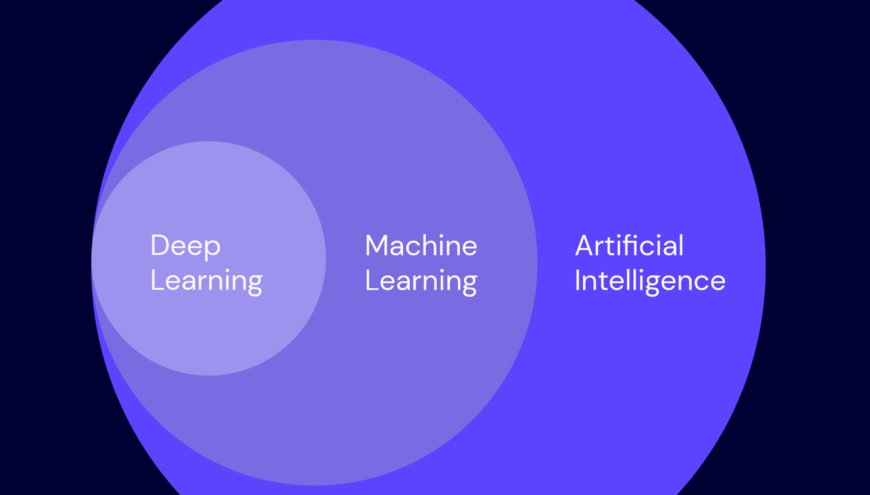
The easiest way to understand the relationship is to think of the three concepts as nested categories.
Artificial Intelligence is the broadest field.
Machine Learning is a subset of Artificial Intelligence.
Deep Learning is a subset of Machine Learning.
In simplified form:
Artificial Intelligence → Machine Learning → Deep Learning
This means that every Deep Learning system belongs to the Machine Learning field, and Machine Learning is part of the broader AI field.
However, not every AI system uses Machine Learning, and not every Machine Learning system uses Deep Learning.
AI vs. Machine Learning
The main difference between AI and Machine Learning is their scope.
AI describes the broader goal of creating systems capable of performing intelligent tasks. Machine Learning describes one of the main methods used to achieve that goal.
Consider a recommendation system on an online shopping platform.
An AI-based system may be designed to provide personalized recommendations. Machine Learning can be used to analyze customer behavior, previous purchases, product views, and other data to determine which products may be relevant to a particular customer.
Therefore, AI represents the broader concept, while Machine Learning provides a data-driven method for building intelligent applications.
Machine Learning vs. Deep Learning
Machine Learning and Deep Learning are more closely related because Deep Learning is a type of Machine Learning.
Traditional Machine Learning methods can work very effectively with structured data and often require humans to select or prepare useful features.
For example, a system predicting house prices might use information such as:
- Location
- Property size
- Number of rooms
- Building age
- Distance from transportation
- Previous sales data
These features can be prepared and supplied to the Machine Learning model.
Deep Learning can automatically discover more complex representations from raw or less-structured data, particularly when large datasets are available.
This makes Deep Learning especially useful for images, audio, video, and natural language.
The Role of Neural Networks
Neural networks are an important part of modern Deep Learning.
A neural network consists of interconnected computational units arranged in layers. Information enters through an input layer, passes through one or more hidden layers, and produces an output.
A simple example is image recognition.
Suppose a neural network is trained to recognize cats. During training, it may gradually learn different visual patterns. Early layers can respond to relatively simple visual features, while deeper layers can combine these patterns into more complex representations.
The system can eventually use these learned representations to make predictions about new images.
How Training Works
AI and Machine Learning systems can be trained in different ways.
One common approach is supervised learning. In this method, the model receives training examples that include known answers.
For instance, a dataset could contain thousands of emails labeled as either "spam" or "not spam." The model analyzes these examples and adjusts its internal parameters to improve its predictions.
Deep Learning models can contain millions or even billions of parameters, depending on the system. Training such models can require substantial computing resources and large datasets.
Real-World Example: Voice Assistants
Voice assistants provide a useful example of how these technologies can work together.
When a person asks a voice assistant a question, several technologies may be involved.
Speech recognition can convert spoken words into text. Natural language processing can help interpret the meaning of the request. Machine Learning and Deep Learning models can contribute to understanding language and generating an appropriate response.
The overall application can therefore be considered an AI system that uses Machine Learning and Deep Learning technologies.
Real-World Example: Image Recognition
Image recognition is another good example.
An AI application may be designed to identify objects in photographs. A Deep Learning model can analyze large numbers of labeled images and learn visual patterns associated with different objects.
A modern computer vision system may identify cars, people, animals, buildings, signs, or other objects within an image.
This technology has applications in manufacturing, security, healthcare research, retail, transportation, and many other industries.
AI, Machine Learning and Deep Learning in Business
Businesses use these technologies for many different purposes.
Machine Learning can help companies analyze customer behavior and forecast demand. AI-powered systems can automate repetitive tasks and provide personalized experiences.
Deep Learning can be particularly valuable when businesses need to process complex information such as images, speech, video, or large amounts of natural language.
For example, an online retailer might use Machine Learning to recommend products while using Deep Learning for visual search and advanced language-based customer support.
Why Data Matters
Data is one of the most important components of modern Machine Learning and Deep Learning.
A model learns patterns from the data used during training. If the training data is incomplete, inaccurate, poorly labeled, or unrepresentative, the resulting model can produce unreliable results.
This is why collecting high-quality data, preparing datasets carefully, and evaluating models properly are important parts of AI development.
More data does not automatically guarantee a better system. The relevance, quality, diversity, and structure of the data also matter.
Which Technology Is More Advanced?
AI, Machine Learning, and Deep Learning should not generally be described as competing technologies.
They represent different levels of scope.
AI is the overall field concerned with intelligent computer systems. Machine Learning is one approach used within AI, while Deep Learning is a specialized Machine Learning approach.
Therefore, asking which one is "better" does not make much sense without considering the specific problem.
A relatively simple Machine Learning model may be more appropriate for a structured business dataset, while Deep Learning may be useful for a complex image or language problem.
Generative AI and Deep Learning
The growth of generative AI has increased public interest in Deep Learning.
Generative AI systems can produce content such as text, images, audio, and computer code. Many modern generative AI systems are built using large neural networks trained on extensive datasets.
Large language models are an important example. They use Deep Learning techniques to process and generate natural language.
This demonstrates how Deep Learning has become an important foundation for many advanced AI applications.
The Main Differences at a Glance
The relationship can be summarized simply:
| Technology | Meaning | Main Focus |
|---|---|---|
| Artificial Intelligence | Broad field of intelligent computer systems | Performing tasks associated with intelligence |
| Machine Learning | Subset of AI | Learning patterns from data |
| Deep Learning | Subset of Machine Learning | Learning complex patterns with multi-layer neural networks |
The three concepts are closely connected, but their scope and methods are different.
Why Understanding the Difference Matters
Understanding these distinctions is useful for anyone interested in technology, business, education, software development, or the future of work.
When a company announces that it is adopting AI, the actual technology could involve a simple rule-based system, a Machine Learning model, a Deep Learning network, or a combination of several technologies.
Knowing the terminology makes it easier to understand what a particular technology actually does rather than treating every intelligent software system as the same thing.
What's Your Reaction?
 Like
0
Like
0
 Dislike
0
Dislike
0
 Love
0
Love
0
 Funny
0
Funny
0
 Angry
0
Angry
0
 Sad
0
Sad
0
 Wow
0
Wow
0