What Is Generative AI and How Does It Work?
Discover what generative AI is, how it works, and how it creates text, images, audio, video, and other content. Learn about AI models, training data, machine learning, and the growing role of generative AI in everyday life and business.

What Is Generative AI and How Does It Work?
Generative AI has become one of the most talked-about technologies in recent years. Unlike traditional software that follows predefined instructions, generative artificial intelligence can create new content based on the information and patterns it has learned. It can write an article, create an image, generate computer code, produce music, summarize information, or help users develop ideas.
The rapid development of generative AI is changing the way people interact with technology. Businesses, students, developers, designers, marketers, and content creators are already using these systems for a wide range of tasks.
But what exactly is generative AI, and how does it work?
What Is Generative AI?
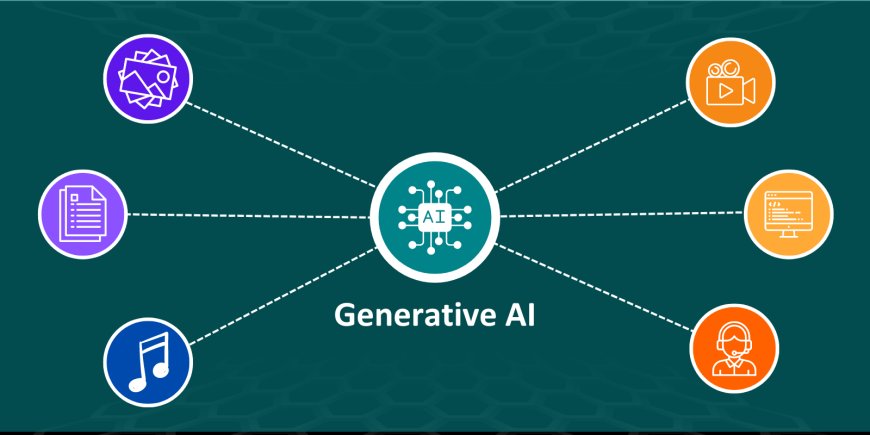
Generative AI is a type of artificial intelligence designed to create new content. The content can take many different forms, including text, images, audio, video, code, and other digital material.
Traditional AI systems are often designed to analyze information, recognize patterns, classify objects, or make predictions. Generative AI goes a step further by using learned patterns to produce new outputs.
For example, a traditional AI system might determine whether an email is spam. A generative AI system, on the other hand, can write an email based on a user's instructions.
This ability to generate content is what makes generative AI particularly useful across many industries.
How Does Generative AI Work?
Generative AI works by using machine learning models trained on large amounts of data. During training, the model analyzes patterns, relationships, structures, and characteristics within the data.
For a language model, this may involve learning how words and sentences are related. For an image-generation model, the system learns patterns associated with visual information.
Once training is complete, the model can use what it has learned to generate new content based on a user's input.
A simplified process looks like this:
- Large amounts of data are collected and prepared.
- An AI model is trained using that data.
- The model learns patterns and relationships.
- The trained model receives a user prompt or instruction.
- The model processes the request.
- New content is generated based on the learned patterns.
The process is considerably more complex in practice, but this basic structure helps explain how generative AI systems operate.
The Role of Machine Learning
Machine learning is one of the fundamental technologies behind generative AI. Instead of programming every possible response manually, developers train models to recognize patterns within large datasets.
During training, the model repeatedly processes examples and adjusts its internal parameters. Over time, it becomes better at identifying relationships within the training data.
For example, a language model can learn that certain words frequently appear together and that sentence structures follow particular patterns. It does not simply store individual sentences and reproduce them word for word. Instead, it develops statistical representations that allow it to generate new sequences of text.
What Are AI Models?
An AI model is a mathematical system that has been trained to perform specific tasks. Generative AI relies on different types of models depending on the content being generated.
Large language models, for example, are designed primarily to work with text. Image-generation models focus on visual content, while other models can work with audio, video, or multiple types of information.
The model's architecture, training process, data, and computing resources all influence the quality of its results.
What Is a Prompt?
A prompt is the instruction or input provided to a generative AI system. It tells the model what the user wants it to create or accomplish.
For example, a user might enter:
"Write a short product description for a wireless keyboard."
The AI analyzes the instruction and generates a response that attempts to satisfy the request.
The quality of a prompt can have a significant impact on the output. Clear instructions, useful context, desired formatting, and specific requirements can help produce more relevant results.
Generative AI and Text Creation
One of the most popular applications of generative AI is text generation. AI tools can produce many different types of written content.
They can help with:
- Blog articles
- Product descriptions
- Emails
- Social media posts
- Summaries
- Business documents
- Creative writing
- Research drafts
- Computer code
- Educational materials
For example, a business owner could use generative AI to create an initial product description and then edit it to match the company's preferred tone.
The technology can therefore function as a productivity tool rather than simply replacing traditional writing processes.
How Does AI Generate Images?
Generative AI can also create images from written descriptions. Image-generation models learn visual patterns from large collections of images and associated information.
When a user provides a prompt describing a scene, object, or artistic concept, the model generates an image that reflects the requested characteristics.
A prompt might describe a modern office, a futuristic city, a product concept, or a particular visual style.
Image generation has become useful in areas such as advertising, design, entertainment, education, and creative development.
Generative AI for Audio and Video
Generative AI is not limited to text and images. Modern systems can also work with audio and video.
AI can be used to generate or modify:
- Voice recordings
- Music
- Sound effects
- Video scenes
- Animations
- Digital presentations
These capabilities are opening new possibilities for filmmakers, musicians, educators, marketers, and content creators.
How Generative AI Is Used in Business
Businesses are increasingly exploring generative AI to improve productivity and automate repetitive tasks.
For example, a company may use AI to draft customer emails, summarize meetings, analyze documents, generate marketing ideas, or assist employees with internal information.
Customer service teams can use AI to create response drafts, while marketing teams can use it for brainstorming and content development.
Generative AI can also support software development by helping programmers understand code, identify potential problems, and create code drafts.
Generative AI in Everyday Life
People do not need to work in technology to benefit from generative AI. These tools are becoming part of everyday digital activities.
Someone might use generative AI to plan a trip, explain a complicated subject, create a study schedule, brainstorm a project, improve a resume, or organize information.
This makes AI increasingly accessible to people who have little technical knowledge.
What Are the Benefits of Generative AI?
Generative AI offers several important advantages.
Faster Content Creation
AI can generate an initial draft within seconds or minutes. This can save considerable time when working on repetitive content.
Improved Productivity
Employees can use AI to assist with routine tasks and focus more attention on activities that require human judgment and creativity.
Personalized Assistance
Generative AI can adapt responses to different instructions and user requirements, making it useful for personalized support.
Creative Support
AI can provide ideas, alternative approaches, drafts, and concepts that help people develop creative projects.
Easier Access to Information
Generative AI can explain complex subjects in simpler language, helping users understand unfamiliar topics.
What Are the Limitations of Generative AI?
Despite its capabilities, generative AI is not perfect.
AI systems can sometimes produce inaccurate information, misunderstand a prompt, or generate an answer that sounds convincing but is incorrect. This is why important information should be checked against reliable sources.
Another limitation is that AI does not have human understanding in the same way people do. It processes patterns learned during training and responds to input based on those patterns.
Privacy, copyright, security, and responsible use are also important considerations when working with generative AI.
Why Human Oversight Still Matters
Generative AI can be extremely useful, but human involvement remains important.
People should review AI-generated information, especially when the content involves business decisions, legal matters, financial information, scientific claims, or other areas where accuracy is critical.
Human creativity, experience, judgment, and understanding of context can complement the capabilities of AI.
The most effective approach is often to treat generative AI as a tool that assists people rather than assuming that it can replace human decision-making in every situation.
The Future of Generative AI
Generative AI is likely to become increasingly integrated into software, online services, workplaces, education, and creative industries.
Future AI systems may become better at understanding complex instructions, working across different types of media, interacting with software, and assisting users with longer and more complicated tasks.
As the technology develops, the focus will not only be on what AI can generate but also on how it is used responsibly and effectively.
What's Your Reaction?
 Like
0
Like
0
 Dislike
0
Dislike
0
 Love
0
Love
0
 Funny
0
Funny
0
 Angry
0
Angry
0
 Sad
0
Sad
0
 Wow
0
Wow
0